
|
By Dr. Joti Samra, CEO & Founder of the Psychological Health & Safety (PH&S) Clinic and MyWorkplaceHealth  Valentine’s Day 2021 – Celebrate Alone or With a Partner
The last twelve months have been incredibly challenging and for some of us, that has meant spending a lot more time alone or possibly some extra strain between you and your partner. Maybe you’ve been separated for extended periods of time due to quarantine and lockdown restrictions or maybe you’ve been stepping on each other’s toes both working from home. This may make Valentine’s Day 2021 a little bit more challenging. Valentine’s Day is approaching quickly and there may be some mixed feelings about it this year. For some, it might feel extra hard for those who are single. Couples may feel like they need the excuse to celebrate their love but are burdened by restrictions. So, why don’t we reimagine Valentine’s Day this year and get creative with how we spend it, regardless of whether or not we are in a relationship! Single on Valentine’s Day 2021 If you’re feeling bad about being single this Valentine’s Day, take a step back and remind yourself how challenging it has been to meet people this year. Be gentle with yourself. It might feel extra hard to be alone this Valentine’s Day particularly if you live alone and have been spending lots of time alone already in the past 12 months. But know that you’re not alone in this feeling. So, what can one do instead of dwelling on the feelings of loneliness? No matter how cliche it may sound, do something nice for yourself. Treat yourself or do something that makes you feel special. It really does work. (And this year, Valentine’s Day is on #SelfCareSunday). Have an at-home spa day, take a nice bubble bath with your favourite drink, take the time to do your 12 step skincare routine, light some scented candles and read a good book. Whatever it is, take the day to do something just for you. Also, consider taking a minute to boost your self-esteem. That not only means to remind yourself that you’re not alone in your feelings but also actively remind yourself of the reasons you are loveable. Consider writing down a few things you love about yourself so you can return to them throughout the day when you’re feeling down. If you’re feeling stuck, ask a few of your close friends what they appreciate about you (but do make sure to come up with a few of your own ideas). If you’re feeling like being alone all day is going to be too challenging, spend time with someone you love (virtually or in another safe manner). Remember there are so many different types of love and romantic love is not inherently more valuable. Creative Date Ideas for Valentine’s Day 2021 Get creative this year with the way you spend Valentine’s Day and do something special with your loved ones. It doesn’t have to be elaborate or expensive, just meaningful. You might be stuck at home but that doesn’t mean you can’t have fun and spend some quality time together. Consider doing something you haven’t been doing together all quarantine to make the day special. Here are some ideas; 1 - Get out of the city and experience nature
2 - Make your favorite meal together. Or order in from your favourite restaurant or from that fancy place you never order from.
3 - Crack open your favorite drink, make some fancy cocktails, or dig out that fancy drink you've been cellaring.
4 - Have a self-care day together
5 - Do something creative together Final Thoughts Remember that Valentine’s Day is just another day. Be gentle with yourself and let yourself feel your feelings if you need to. Instead, get creative and find a nice way to spend the day regardless of whether or not you’re in a partnership or single. By Dr. Joti Samra, CEO & Founder of the Psychological Health & Safety (PH&S) Clinic and MyWorkplaceHealth  Five Steps To Building Authentic Relationships All of my clients, and anyone who’s heard me speak, has heard me – often – talk about how we as humans are fundamentally social creatures. It’s our social relationships that help us not just survive but thrive in spite of the inevitable life challenges we will all be faced with. Data doesn’t lie – and research tells us that our social relationships are among the top factors that help us live a long, physically and emotionally healthy and satisfying life. Good relationships often serve as a buffer during hard times and can deepen the quality of good times. But building authentic relationships can seem daunting and it can take a lot of courage to be vulnerable with people. Building Authentic Relationships So, what can we do to help us build strong authentic relationships? 1. Assess who is currently in your life. Be mindful of who you let in and out of your life. Intuition is a great guide here! You want to make sure that you aren’t unnecessarily using energy on unhealthy or negative relationships. 2. Be intentional. Be intentional about making time for those people in your life around whom you feel most yourself. Don’t allow distance, time or life demands to get in the way – texts, emails, and photos are beautiful ways to stay connected in between in-person visits (this is where social media can serve some very useful functions!) 3. Reflect. Reflect on what parts of yourself you’re finding difficult to reveal or share with others. Ask yourself why? What would be the worst thing that would happen if others knew about your greatest fears/insecurities/worries/challenges/or weaknesses? 4. Be Vulnerable. Make a commitment to push yourself out of your comfort zone in terms of how and what you reveal to others. Challenge yourself by asking “what’s the worst thing that will happen?” Start with revealing small aspects of yourself – and see and observe what happens. I promise the sky won’t fall down! 5. Listen and Ask Questions. Ask questions with genuine curiosity and listen to the answer. Asking questions, particularly open-ended questions, is one of the best ways to get to know someone better. Remember to listen actively. Typically we listen with the intention to respond, so some of our attention is spent considering and preparing our response. Listen fully to what the other person is saying and allow yourself to be vulnerable in the fact that you won’t necessarily know how to respond right away. Try to be comfortable in silence as you allow yourself to formulate a response after they’ve finished. Remember: our relationships are everything. And it’s a beautiful feeling when we can truly be our authentic selves to those closest in our lives. So take the time to build authentic relationships in your life! By Dr. Joti Samra, CEO & Founder of the Psychological Health & Safety (PH&S) Clinic and MyWorkplaceHealth The question:
I have a hard time meeting new people. Everyone else seems so outgoing, posting personal items on Facebook and chatting up strangers in bars. How do get myself out there and noticed? The answer: Meeting new people can be a challenge at the best of times, and it just gets harder with age. Be mindful, however, that your perceptions of the ease with which other people meet is likely a bit skewed. It’s a hard thing for many people. Consider your reference points, as what we find difficult can feel even more challenging if we (mis)perceive them to be easy for others. Facebook and other social media sites are, in many respects, an artificial form of communication. There are certainly many positives that come with these sites, such as staying in touch with friends and sharing photos. Unfortunately, new technologies are leading to societal shifts in which people tend to engage in less direct communication (face-to-face or phone) and more indirect, ostensibly distant communication (online messaging, texting). This can lead to a false sense of connection with others. Interestingly, recent research has found an inverse correlation between the number of Facebook “friends” adolescents had and the number of actual close relationships they reported having. So what you see on Facebook is not necessarily an accurate reflection of how social or outgoing someone is. Similarly, bars are not the best place to judge how confident others seem to be, as interactions there are often enhanced by the presence of alcohol. I’m not sure what wanting to get “out there and noticed” means. Do you want to meet more acquaintances or friends? Do you want to meet people you can go to social events and activities with? Do you want to meet potential dating partners? Articulate and write down specifically what you want. Then determine ways to achieve your end goal. For example, if your goal is “having a running partner”, your list of actions may include “join a running club” or “strike up a conversation with runners I see frequently at the local track”. Identify the barriers that you have in talking to others. Do you feel insecure? Do you get shy and clam up? Do you have difficulty knowing how and when to start a conversation? If shyness or anxiety plays a role, I would suggest getting The Shyness and Social Anxiety Workbook: Proven, Step-by-Step Techniques for Overcoming Your Fears by Martin Antony and Richard Swinson, which is an excellent, evidence-based workbook with strategies to manage social anxiety. Excerpted from Dr. Joti Samra’s “Ask the Psychologist” weekly column in The Globe and Mail. By Dr. Joti Samra, CEO & Founder of the Psychological Health & Safety (PH&S) Clinic and MyWorkplaceHealth The question:
I love my boyfriend very much, he is warm, loving and giving. However, when I imagine my life five years from now I have a hard time seeing him in it. We come from different academic backgrounds – I have a B.A. and a college certificate, he never finished college. I want to get married and have kids, and while he says he wants to, he only very recently starting saving. Sometimes I feel I’m being snobbish or not giving him enough time to change. After a three-year relationship, I don’t know whether to wait this out or to leave. This has consumed my thoughts for four months and is making me so anxious I almost have panic attacks. What should I do? The answer: The amount of distress you are feeling about whether or not to continue your relationship – and the fact that you are even questioning whether you see him in your future – is the biggest sign you have about what to do next. Fleeting doubts and questions about long-term compatibility are very normal and come and go even in long-term, solid relationships. Pervasive and significant doubts that last months or longer are not. Often, our emotional reactions provide us with useful information about our circumstances, even before we can verbally articulate what those reasons are. You are likely reacting to a number of factors, and you know at a gut level that the relationship, for a range of reasons, is not the best fit for you. You need to trust this reaction. All too often we go through life ignoring our intuition – despite the fact that it often tells us what we need to know. Think about the significant decisions in your life so far, with a particular focus on regrets you have or mistakes you made. Likely, your intuition almost always gave you a sign as to what to do, but you ignored it. There are clearly a number of very positive attributes about your boyfriend that you admire. However, the reality of long-term relationship success is that there often needs to be compatibility at a number of levels such as personality, interests, and finances. Are these differences that the two of you could potentially work through? Yes, of course. However, forcing the issue and trying to work hard at accepting fundamental differences between the two of you isn’t necessarily the best way to move forward given the extent of doubts you already have. You are clearly torn about what to do, and not yet ready to let go. Given this, the next step for you – both for peace of mind, and to do justice to the three years you have spent together – is to have some candid conversations. You will need to balance being respectful with being straightforward – for example, rather than specifically outlining the differences in education (which may feel very hurtful to him) you may say that you worry your personalities and career interests are very different. These conversations will likely be heart-wrenching, but it is what you need to do. Keep in mind that it is possible to have love for another person without being in love with them and spending your life together. And, it will be much less painful to end the relationship now, rather than down the road if you were married and/or had children. Excerpted from Dr. Joti Samra’s “Ask the Psychologist” weekly column in The Globe and Mail. By Dr. Joti Samra, CEO & Founder of the Psychological Health & Safety (PH&S) Clinic and MyWorkplaceHealth The question:
New Year’s always makes me anxious. All this talk of resolutions, starting fresh and getting everything done – why? Between problems with my marriage, children and work, I know I have a lot to figure out – but New Year’s just gives everyone I know a chance to ask insensitive questions about how am I going to change things in the next 365 days. How do I make it stop? The answer: Any time we have a strong emotional reaction to a situation, we should ask ourselves two key questions: Is my reaction accurate, realistic or appropriate given the situation? And if the intensity of the reaction seems mismatched to the situation, what is it that I am truly reacting to? The tradition of making New Year’s resolutions is a common one across the world. The new year, for many people across cultures and societies, represents a new start and new beginning. Virtually all people have rituals and traditions to celebrate the onset of a new year. So why has the tradition of resolutions been adopted and why has it stuck in so many parts of the world? What resolutions provide are an opportunity to reflect on the past and think about improvements one wants to make to their life. They symbolize a commitment to achieve personal goals, complete projects or break bad habits. Time and time again, the most common resolutions relate to diet, weight, smoking or substance use. Are resolutions themselves indicative of anything? If you look at the statistics, the answer is no. I came across one study that indicated 94 per cent of people forget what their resolution is by July! So why do people continue to make them? I think it really comes down to a light and fun tradition that ultimately reflects our wishes and hopes for positive future changes. I believe that all of us are fundamentally works in progress, and an important part of our personal journey involves identifying – and makes changes to – areas of our lives we are less than satisfied with. Your reaction, however, seems to represent something starkly different from a light, fun way to reflect on change. You indicate you have problems in important parts of your life, that you have a lot to figure out. Your perception of insensitivity seems to be a projection of the dissatisfaction you have with your life more than anything else. I would encourage you to spend some time thinking about why you are having such an intense reaction. It sounds like you are frustrated with life situations you may feel you have little to no control over. Ask yourself what changes you may want to make in your life, and what your perceived barriers are to making those changes. Maybe you aren’t in a position where you are able or wanting to make the changes you need, which is a perfectly acceptable. However, your dissatisfaction has very little to do with the question-askers. The answer to your question of how to make it stop is a simple one: You can’t stop others’ questions. Period. You can, however, abort the conversation with a simple, lightly delivered line: “I don’t believe in making New Year’s resolutions. What are yours?” Excerpted from Dr. Joti Samra’s “Ask the Psychologist” weekly column in The Globe and Mail. By Dr. Joti Samra, CEO & Founder of the Psychological Health & Safety (PH&S) Clinic and MyWorkplaceHealth The question:
I’m dreading seeing certain members of my family over the holidays. I wish I enjoyed spending time with them more but I end up feeling tense and uncomfortable. How can I make the best of it? The answer: You are not alone: The holidays are one of the most stressful times of the year for many people. Most of us are trying to do too much in too little time at this time of year. December and January are months where we incur the highest amounts of debt. The dark and dreary days negatively impact mood for many people and can compound existing stressors. Add to the mix the fact this is one of the only times of year that we are thrown together with our relatives – whether we like them are not – and you have a perfect recipe for stress! There are a number of things you can do to make the holidays go more smoothly:
Finally, try to find what humour you can in your family situation. Remind yourself that the season will soon be over, and you will get through it like you do every year. By Vanessa Rouzier, RCC 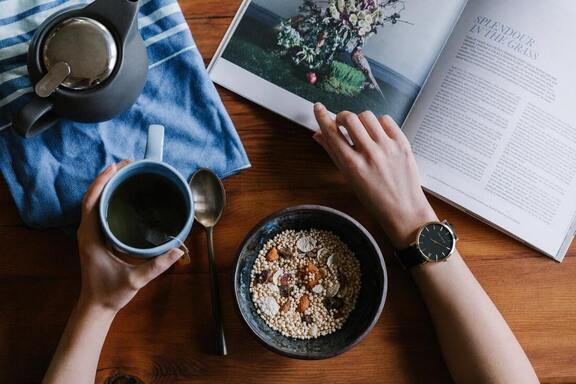 We know the way we eat not only influences the way we feel physically, but also mentally. More specifically, our diet affects the production and transmission of serotonin and dopamine in our brain. These are commonly known as “happiness neurotransmitters” which have a significant impact on our mood. Our eating habits also influence cortisol levels in our brain, which is the stress hormone.
There is so much information out there about diet that it can be challenging to know where to start when it comes to eating healthy. If you made eating habits one of your new year’s resolutions, here are some strategies to help you begin. How to Make Changes Related to Diet 1 - Define your goal Target one specific behaviour you would like to change at a time. A smaller and more realistic goal is often better as it will be easier to reach. This will leave you with a sense of achievement and more motivation to continue. Your goal should also be in line with your vision of the future. Try to find the reason why you want to make that change. Is it to have more energy? To be healthier? More attractive? More productive? When you feel like giving in to a craving, connecting with that deeper motivation will help you stay strong and make healthier choices. 2 - Limit your sugar intake Sugar overconsumption has not only been shown to be one of the main contributors to weight gain, but it also has an impact on brain functioning. Research has linked sugar overconsumption to cognitive impairment, anxiety and depression. Academics have also shown that sugar is “tricking your brain” as it is increasing the impulsivity to feed. This means the more sugar you eat, the more you want to eat overall! 3 - Find strategies to manage your stress Emotional eating is very common. After eating high-fat or high-sugar food, the brain releases hormones that reduce the feelings of stress, which makes you want to have more. The “reward pathway” involved in your brain is similar to the one involved in addiction to drugs or alcohol. Find alternative ways to manage your stress. This will allow you to obtain a similar calming result, without the extra calories! Breathing exercises, mindfulness, meditation, yoga, aromatherapy, engaging with your favorite hobbies, and physical exercise are some good and healthy ways to cope with stress on a daily basis. 4 - Improve your sleep quality Research has shown sleep deprivation decreases the activity in the region of your brain responsible for assessing hunger, as well as in the region that controls cravings. Therefore, sleep loss boosts your appetite and drives you toward high-calorie food. As a result, a regular sleep schedule can help you regulate your sleep and therefore help you with your diet. Some other sleep strategies include avoiding screen time before bed and having a consistent bedtime routine. 5 - Seek professional help if you are feeling depressed or if you have experienced trauma Research shows that the relationship between mental health and diet is bidirectional. This means the way you eat affects how you’re feeling as much as your mental state affects your eating habits. For example, depression can increase or decrease your appetite, lower your motivation to cook or move and be associated with more cravings. As for trauma, it can lead to a state of “hypervigilance” or to a sense of “numbness”, both affecting hunger signals, which in turn can lead to poor eating habits. If you’re experiencing mental health challenges, it can be helpful to have the guidance of a mental health worker to approach the changes you want to make from a more global perspective. Reach out to the Psychological Health and Safety Clinic today to speak with a clinic counsellor. Final Thoughts on Diet and Mental Health A lot of us are struggling as a result of the stresses we’ve experienced over our lives. So, it’s important to remember to be gentle with ourselves and our bodies as we move into the new year. Yes, our diet is connected to our mental health and wellness, so we can set good intentions about eating healthy and moving our bodies in a way that feels good without focusing on weight loss. By Dr. Joti Samra, CEO & Founder of the Psychological Health & Safety (PH&S) Clinic and MyWorkplaceHealth The question:
My 12-year-old still believes in Santa. It’s embarrassing, but he’s still so hopeful and it’s endearing. I feel responsible. How do I tell him without crushing his spirit? The answer: The short answer? Tell him the truth. The longer answer is that, for me, one of the most amazing things about children is the innocence and enthusiasm of their beliefs. Parents can feel heartbroken, shattering these beliefs with the reality of life – particularly when they have such awe about the wonders of the world. However, this is a part of raising a child and preparing them for the real world. Remember that children can be cruel, and given that he is of an age where the majority of kids know and accept that Santa does not exist – let him know sooner rather than later so that he is not unnecessarily teased. Keep in mind that our modern day Santa has several core roots, including Saint Nicholas who was a historical saint and bishop from the 4th Century. So, there is in fact a historic Santa that does exist – just not the way your son (and most other children) believe. This is important to communicate to him when you break the news – so that he does not feel that he has been told a completely fabricated piece of information. See this as a teaching opportunity. You can introduce the topic by telling your child of Saint Nicholas and how he was recognized and admired for his secret gift-giving. You can talk about the value behind unconditional giving to those that are less fortunate and in need. And then you can gently let your son know that there are actually many “Santa-type” people in the world – that care for and give to others, such as parents, grandparents and other loved ones. Depending on his intellectual maturity, you can describe to him that the Santa portrayed in the media and in the public is a metaphor for or a symbol of those that give. And ultimately you can let him know that it is you, not the big man in red, who provides him with gifts. He may get upset or tearful. He may ask you why you have lied – and you should be honest. State that this is part of the tradition of Christmas, it is part of what makes Christmas fun, and that virtually all other kids (and likely you, at one point) believe in Santa. Remember – parents have been breaking the news that Santa really doesn’t exist for decades, and will continue to do so with no evidence of any long term damage to kids. Excerpted from Dr. Joti Samra’s “Ask the Psychologist” weekly column in The Globe and Mail. By Dr. Joti Samra, CEO & Founder of the Psychological Health & Safety (PH&S) Clinic and MyWorkplaceHealth The question:
My mom is a terrified driver. She’ll stop in the middle of an intersection, paralyzed by fear. She’s recently been involved in a few traffic accidents, although none of these were her fault. She recently ended a 30-year marriage. Are these incidents related? I’m afraid to criticize but I’m concerned for her safety. The answer: Driving-related fears and phobias can be attributed to a number of causes. Some people are just naturally more nervous drivers – individuals who don’t drive often, older adults, and those who have moved from smaller communities to higher traffic-populated areas tend to be less comfortable behind the wheel. It sounds as though you have noticed some recent changes in your mother’s driving behaviour, both in terms of her fear (which I’m imagining she has told you about or you have witnessed directly) and also a higher than average number of accidents over the last short while. Even though the accidents were not her fault, there could be the possibility that she is engaging in less defensive driving behaviours which may indirectly have increased the likelihood of her being in several accidents in a short period of time. If she has recently ended a 30-year marriage she is likely under a higher than average level of stress (even if she chose to end the marriage) and it may be that her elevated stress is manifesting in her driving behaviour. When there is an increase in our baseline level of stress, we tend to have amplification of already existing fears or anxieties. For example, it could be that she was always a slightly nervous driver but the increased stress has now contributed to tipping that nervousness into more concerning fears. Being in a number of accidents over a short while can in and of itself lead to an increased fear of driving, which may from the outside look out of proportion to the severity of accidents that occurred. A number of factors can contribute to quite significant driving-related phobias developing from even minor accidents. Some of the factors include previous number of accidents, physical/emotional health history, other existing stressors, and the nature and circumstances of the accident. Finally, it is important to keep in mind that other changes in her physical or cognitive health status may be influencing her driving-related fears and behaviours. Health conditions that in particular impact one’s cognitive processes or eyesight (e.g., cataracts, stroke, early onset dementia) can also play a role. I can appreciate the concern about not wanting to criticize, but given the safety risks (both to your mother and to other drivers) this is something you need to bring up with her. Take a non-accusatory approach with her. Explicitly state that you don’t want to come across at all critical, but that you have concerns about her safety and have been worried about her recent accidents. Make sure you emphasize that you know they were not her fault, but that you are concerned nonetheless. Be specific and objective about the concerns you have (i.e. give specific examples that lead you to say she is “terrified” or “paralyzed by fear”). Offer to go to her family physician with her. This can be helpful to ensure she has had an examination of her physical function, including eyesight. If it seems that stress-related causes are the sole cause of her fear, the most effective treatment is cognitive-behavioural treatment (which focuses on addressing anxiety-related thoughts and behavioural responses to these thoughts). Excerpted from Dr. Joti Samra’s “Ask the Psychologist” weekly column in The Globe and Mail. By Dr. Joti Samra, CEO & Founder of the Psychological Health & Safety (PH&S) Clinic and MyWorkplaceHealth The question:
My teen daughter is fat. She’s way over her normal BMI, and I’ve tried talking to her – politely – and asking if she wants to go to the gym together, or work out a healthy meal plan. It just seems to make it worse – she eats way more after our talks. What can I do? The answer: There are two main things you need to consider: the factors that contribute to your daughter’s current weight and the manner in which your concerns have been communicated to her. You say that your daughter is “way over” her normal Body Mass Index (BMI). I will assume that she falls close to or within the “obese” range. By definition, obesity is a medical condition where amount of body fat may adversely and significantly impact health, including increasing the likelihood that one will develop a range of serious health conditions and contributing to shortened life expectancy. For these reasons, expressing your concern and trying to improve your daughter’s health is important. Try to support her to make some changes. For all of us, our weight is the result of many factors – including those that are out of our control (e.g., genetic predisposition) as well as factors that are controllable (e.g., eating habits, exercise/activity levels). Unidentified or untreated health conditions (e.g., thyroid dysfunction) may also play a role. For this latter reason, ensure your daughter has had a recent medical examination. Unfortunately there is considerable stigma in our society regarding weight issues. I wonder to what extent your daughter has dealt with teasing or negative attitudes from family, friends, and kids at school. This could likely be contributing significantly to her feelings of low confidence and self-esteem, including feelings of shame and even low mood or depression. Your daughter may feel hopeless – particularly when kids deal with obesity from a young age, they may develop strongly ingrained beliefs that nothing they do will be effective in terms of changing their situation. You indicate that your daughter eats “way more” after your talks. Many individuals (even those that do not struggle with obesity) engage in emotionally-driven eating and this leads me to think she is likely becoming highly stressed after your conversations. Think about how you are approaching these conversations: it is important to remain non-judgmental, non-accusatory and supportive in your verbal and non-verbal communication. Express to her genuinely why you are concerned about her weight rather than telling her what to do (as this may come across as lecturing and critical). Ask her what her goals for weight/food/exercise are, and if there are ways that you can support her goals. The reality is she may find it too difficult to speak openly to you given history. Offer to help her find a professional (family doctor, dietitian, nutritionist, psychologist) with whom she could speak to openly and confidentially. Excerpted from Dr. Joti Samra’s “Ask the Psychologist” weekly column in The Globe and Mail. |
PH&S ClinicEnhancing psychological health, wellness and resilience Archives
April 2024
Mental Health
All
|
 RSS Feed